Cementitious Waterproofing Service in Qatar, UAE & Saudi Arabia
Cement-based waterproofing is the most reliable method for concrete structures that need long-term protection from water pressure — tanks, basements, foundations, and below-grade construction. Compass Waterproofing delivers rigid and flexible cementitious systems across the GCC, with products certified safe for potable water contact and compliant with all GCC authority standards.
What Is Cementitious Waterproofing?
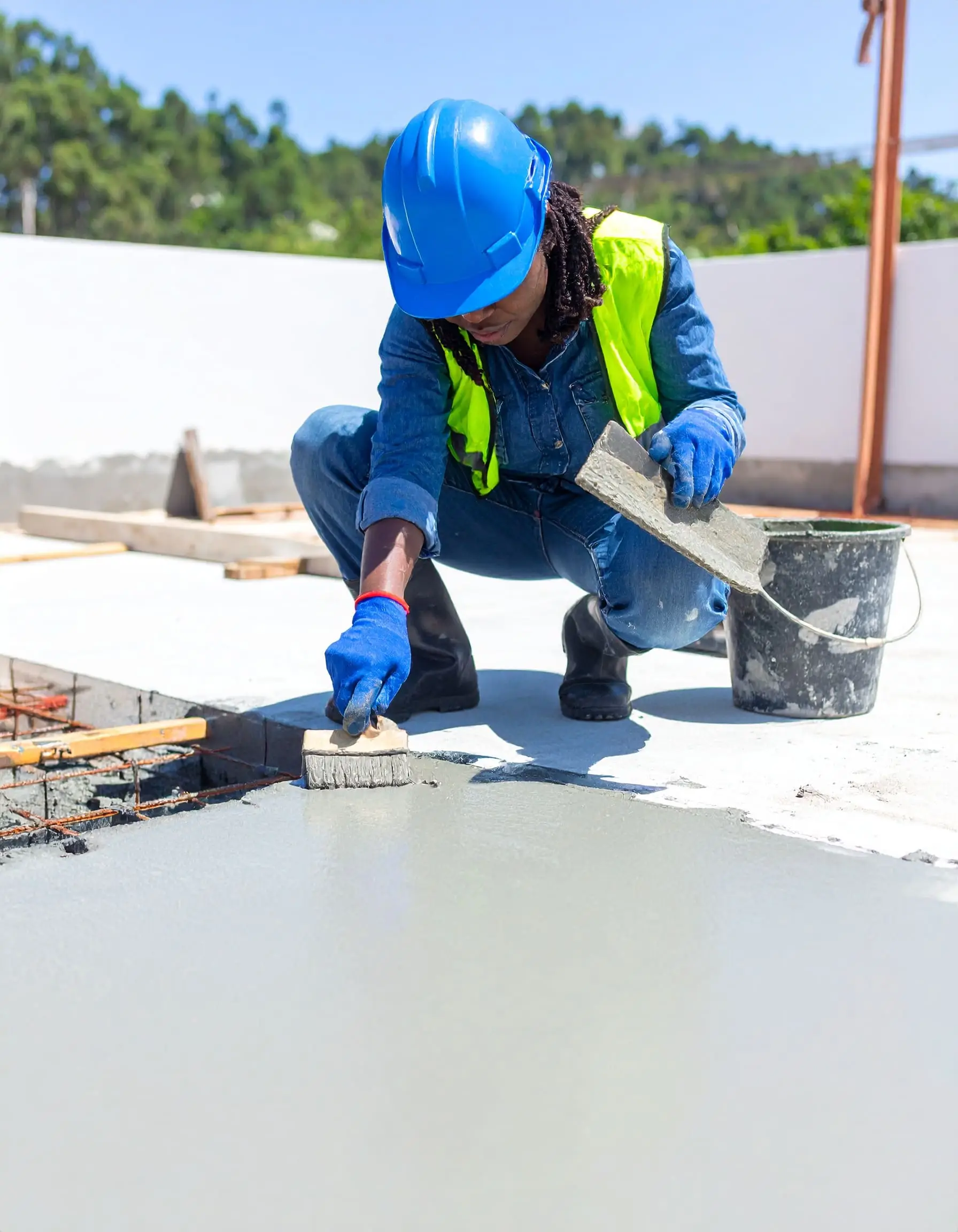
Cementitious waterproofing is a cement-based system applied to concrete surfaces to block water penetration. It works by chemically bonding with the concrete substrate — becoming part of the structure rather than just sitting on top of it. That is what makes it one of the most durable waterproofing methods available.
There are two main types. Rigid cementitious systems are set hard after application and are ideal for structures that do not move — water tanks, swimming pools, and reservoirs. Flexible cementitious systems contain polymer additives that allow slight movement, making them suitable for foundations, basement walls, and wet areas that may experience minor structural settlement.
In the GCC, cementitious waterproofing is widely used in water infrastructure, basement construction, and swimming pools. It is one of the few systems certified safe for direct contact with drinking water — making it the preferred choice for Qatar and Saudi Arabia’s large-scale water storage and distribution projects.
Our teams apply cementitious systems in Qatar, UAE, and Saudi Arabia using certified products — including Mapei Mapelastic systems — that meet ASTM C1329, BS EN 1504, and local authority specifications including Ashghal PWA in Qatar and Dubai Municipality standards in the UAE.
What Cementitious Waterproofing Can Do
- Stops water ingress under hydrostatic pressure
- Bonds chemically with concrete — no adhesion failure
- Safe for potable water tanks and reservoirs
- Withstands both positive and negative water pressure
- Remains effective in permanently wet conditions
- UV and heat stable — no degradation in GCC summers
- Compatible with tile adhesives and fl
6 Signs Your Concrete Structure Needs Cementitious Waterproofing
These are the most common warning signs we see on GCC buildings and infrastructure projects. If you notice any of these, early action prevents major structural damage.
Visible Water Seeping Through Walls
If water is staining or actively seeping through basement walls or below ground structures, then hydrostatic pressure is winning. This right away is blocked by cementitious coating applied from inside.
White Powder on Concrete Surfaces
Efflorescence, or white salt deposits, results from water moving through the concrete and evaporating on the surface. It’s an early sign that moisture is already entering the structure.
Swimming Pool or Tank Losing Water
If your pool, water tank or reservoir is losing water faster than evaporation can account for, that’s because of micro-cracks in the concrete that are allowing seepage. The proper repair is a cementitious lining.
Mold Growth In Basement Or Wet Area
Continual damp and mould in below ground spaces or wet rooms is usually an indication of moisture coming through the slab or walls. Cementitious coating seals the source, not just the symptom.
New Build Pre-Tiling
Apply a cementitious waterproofing layer before tiling wet areas, bathrooms, plant rooms and water feature bases. This is one of the most common reasons for tile failure.
Water Infrastructure Development
The cementitious lining of water treatment plants, sewage structures, underground cisterns and irrigation channels is necessary to meet the specifications of the GCC authority and to obtain a long service life.
Our Services
Talk to Our Team
Our 6-Step Cementitious Waterproofing Process
Every cementitious waterproofing project we deliver follows the same process — no shortcuts, no skipped steps, full documentation at handover.
Site Assessment
Structure inspection, moisture & hydrostatic pressure checks before specifying the system.
System Specification
Rigid, flexible, crystalline, or slurry — with full method statement for approval.
Surface Preparation
Cleaned, degreased, and mechanically prepared; cracks filled first.
Detail Treatment
Corners, joints & penetrations treated first with fillet mortar.
Multi-Coat Application
Two+ coats at specified coverage, thickness monitored throughout.
Flood Test & Handover
Documented flood test + warranty certificates at handover.
Reasons GCC Contractors Choose Us
These are the things that separate Compass Waterproofing from material suppliers and generic applicators working in Qatar, UAE, and Saudi Arabia.
01Certified Potable Water Products
Our rigid cementitious systems are NSF-certified and approved for direct contact with drinking water — meeting Qatar KAHRAMAA, Saudi Aramco, and UAE ADWEA specifications for water infrastructure.
02Full Authority Compliance Documentation
Every project is delivered with method statements, product data sheets, inspection reports, flood test certificates, and bilingual Arabic/English documentation for Saudi Arabia government submissions.
03On-Ground Teams in Qatar, UAE & KSA
We have permanent technical teams across all three GCC countries — not subcontracted applicators. The team that quotes your project is the team that applies the system.
04GCC Climate Experience
We understand the specific challenges of cementitious application in extreme heat — application timing, curing conditions, and hydration management in 45°C+ summer temperatures across Qatar and Saudi Arabia.
05ASTM, BS & ISO Compliant Products
All cementitious products we use carry current test certificates and are compliant with ASTM C1329, BS EN 1504, and ISO standards required by GCC consultants and government authorities.
06Installation & Repair Services
We participate in new construction and remedial projects – repairing failed waterproofing, sealing active leaks and relining existing tanks and pools without complete demolition and reconstruction.
Common Questions About Cementitious Waterproofing Service in GCC
What distinguishes polyurethane crack injection from epoxy?
When load transfer needs to be reestablished in dry or slightly moist structural fissures, epoxy injection is used. Compared to the surrounding concrete, it is stronger and more stiff. For active, wet leaks, polyurethane foam injection works by reacting with moisture, expanding to fill the space, and instantly creating a flexible, waterproof cover. Epoxy won’t work on a damp fracture because the moisture inhibits effective bonding and curing.
Is it possible to inject cracks while water is actively leaking?
Yes, and this is the exact situation in which polyurethane foam injection is employed. To initiate its expansion process, PU resin requires moisture. Even under hydrostatic pressure, it reacts with the water when injected into a crack that is actively leaking, expands quickly, and shuts the leak in a matter of minutes. Because waiting for dry circumstances is impractical, it is the only workable remedy for GCC basement and underground structure leaks.
How can I determine whether a crack is non-structural or structural?
Load-bearing components, such as walls, slabs, beams, and columns, are impacted by structural fissures. They usually run across the element, may be deflected, and need to be strengthened by epoxy injection. Non-structural cracks, which are sealed to stop moisture intrusion rather than to restore strength, are brought on by thermal movement, shrinkage, or settlement and have no effect on load capacity. Before prescribing a treatment, our technicians accurately evaluate and categorise each crack.
In GCC settings, how long does crack injection last?
If the cause of the fracture has been addressed, a correctly performed crack injection utilising the appropriate material for the crack condition will result in a permanent seal that lasts the lifetime of the structure. The crack next to the injected part may reactivate if the underlying cause settlement, overloading, or corrosion continues to affect the structure. For long-term outcomes in GCC buildings, accurate crack assessment and root cause identification prior to injection are crucial.
What is the minimum crack width required to enable injection?
Crack injection works well on cracks as small as 0.5 mm for polyurethane foam and as small as 0.1 mm for epoxy systems. Injection can effectively fix the majority of visible concrete cracks, which usually begin at 0.2 to 0.5 mm. Injection may not be appropriate for extremely fine surface crazing or map cracking; instead, surface-applied waterproofing coatings may be needed. The right strategy for each unique fracture condition will be verified by our evaluation.