Crack Injection Service in Qatar, UAE & Saudi Arabia
Cracks in concrete are more than just a surface problem. If you don’t treat it, the hairline crack becomes the path for water to get into the steel reinforcement inside and that will start a corrosion cycle that eats away at your structure slowly but surely over time. Our crack injection service uses certified epoxy and polyurethane systems to permanently seal cracks from the inside.
- Epoxy Injection
- PU Foam Injection
- Active Leak Repair
- Structural Cracks
What Is Crack Injection & Why Does Your Building Need It?
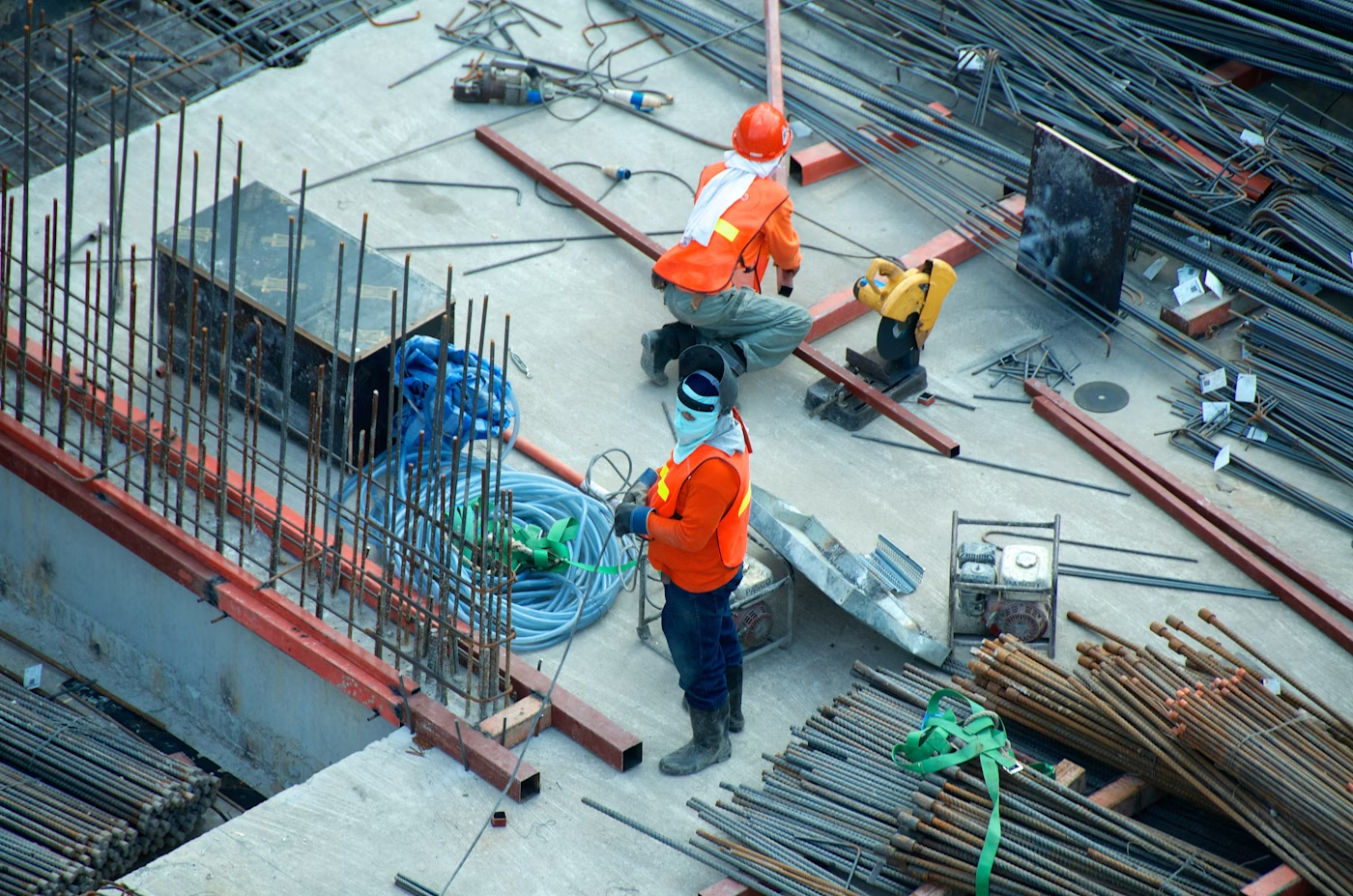
Crack Injection is a specialist waterproofing and structural repair technique for sealing cracks in concrete and masonry structures. A high-performance resin (epoxy or polyurethane) is injected under controlled pressure directly through a series of ports installed along the length of the crack.
The resin penetrates to the full depth of the crack and fills every void and hardens to a lasting, watertight bond. The result is a sealed crack that can no longer permit the penetration of water, moisture or aggressive agents into the structure.
Crack injection is one of the most important repair services available for GCC buildings all over Qatar, UAE & Saudi Arabia. Concrete cracks here are not only more common, but also develop at a faster rate and cause more structural damage than in most other climates worldwide, due to the combination of extreme heat, coastal salinity, UV radiation and thermal cycling.
Waiting always costs more than early crack injection. A crack that costs a few hundred riyals or dirhams to inject today can lead to thousands of dollars in spalling, rebar replacement and structural repair if left untreated for a season or two.
Signs Your Building Needs Crack Injection Now
These are the signs that concrete cracks in your GCC building have already started causing damage and that crack injection is needed before the problem gets significantly more expensive to fix.
Water leaking through the walls
If you can see water stains, damp patches or active water ingress through basement walls, underground car parks or below grade structures cracks are letting in direct water ingress that needs immediate injection treatment.
Rust Stains on Concrete
Brown or orange staining on concrete surfaces is a clear sign that the reinforcing steel inside the concrete is corroding. Existing cracks or porous concrete have allowed moisture to get to the rebar Crack injection and rebar treatment needed urgently.
Cracks in Sight Growing Larger
Structural cracks under active loading or movement are defined as those visibly widening over weeks or months. These require immediate epoxy injection assessment to restore load transfer and stop progressive structural failure.
Concrete Surfaces Shouldered
ConIf chunks of concrete are breaking off walls, ceilings or columns the steel inside has already corroded enough to cause delamination. At this stage full concrete repair and injection treatment is required as crack injection alone is no longer sufficient.
Damp or Musty Smell Inside
A persistent damp or musty smell in basements, lower floors or enclosed spaces is often an indication of moisture intrusion through concrete cracks that are not visually evident from the surface. Injecting the cracks early prevents mould growth and structural deterioration.
Cracks After Construction
In Qatar, UAE and Saudi Arabia, settlement cracks, thermal cracks or shrinkage cracks can develop in new buildings during or shortly after construction. These should be evaluated and injected early before the GCC climate widens them and allows moisture in.
Our Services
Talk to Our Team
Two Types of Crack Injection - Choosing the Right One Matters
Using the wrong injection material is one of the most common mistakes in concrete crack repair. Epoxy and polyurethane are both excellent but they perform very differently and are suited to completely different crack conditions.
Epoxy Crack Injection
Epoxy injection is used for structural cracks in concrete that are dry or only slightly damp. When cured, epoxy forms a rigid, high-strength bond across the crack that actually exceeds the tensile strength of the surrounding concrete, fully restoring structural continuity and load transfer.
It is the correct specification for load-bearing elements, beams, columns, slabs, and foundations where crack movement has stopped and the concrete needs to be restored to its original structural capacity.
Best Used For
- Structural beams, columns & slabs
- Foundations & retaining walls
- Parking decks & bridge structures
- Industrial floors with structural cracking
- Dry or slightly damp concrete cracks
Polyurethane Foam Filling
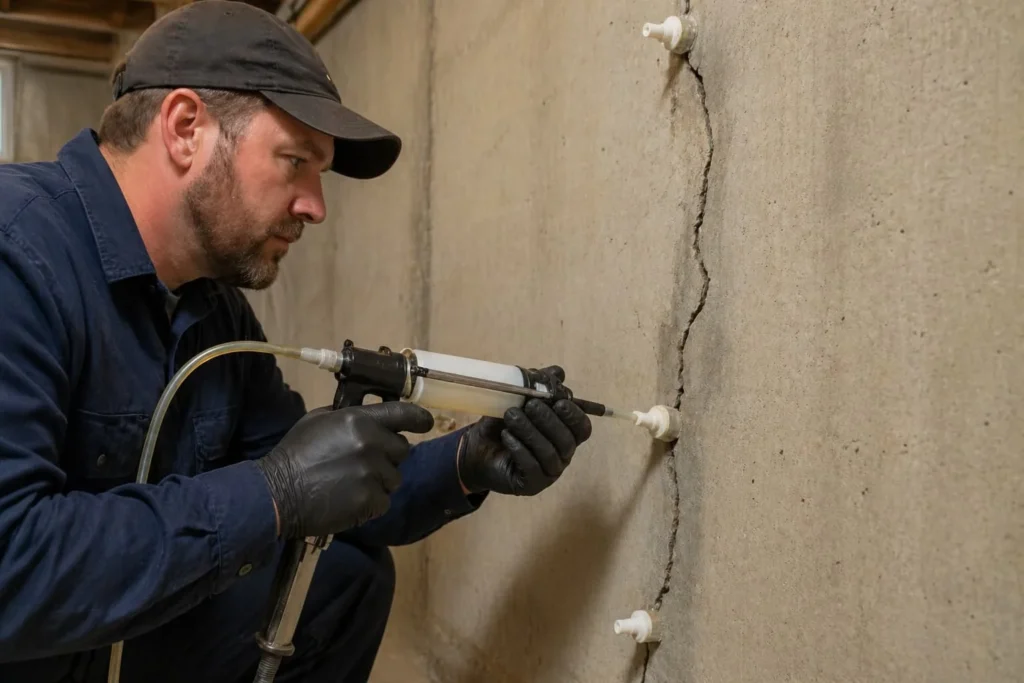
Polyurethane foam injection is the answer if water is present or flowing through the crack at time of repair. PU resin is chemically reactive to moisture; it needs water to work. It grows up to 30 times its original volume when it comes in contact with moisture inside the crack , filling up all the voids and cures to a flexible , watertight foam seal .
This is the only practical solution for basement walls, underground car parks, tunnels and water tanks where waiting for dry conditions is not an option: it seals active leaks immediately, even under hydrostatic pressure.
Best Used For
- Active water leaks & flowing cracks
- Basements & underground car parks
- Tunnels & below-grade structures
- Water tanks & lift pits
- Wet or saturated concrete cracks
How Our Crack Injection Service Works Step by Step
Every crack injection job we carry out follows a consistent, professionally managed process from initial assessment through to documented handover. No guesswork, no shortcuts.
Crack Assessment & Mapping
Every crack is examined by our technician, who measures its length, width, depth, and pattern. We evaluate whether the fracture is wet or dry, active or dormant, structural or non-structural. Before any work is done, this evaluation establishes the proper injection substance and technique.
Root Cause Identification
We determine whether the crack was caused by corrosion, thermal movement, overloading, settlement, or a construction flaw. If a crack is injected without knowing what caused it, there is a chance that it will recrack following the repair. Before moving further, we try to address the reason.
Port Installation
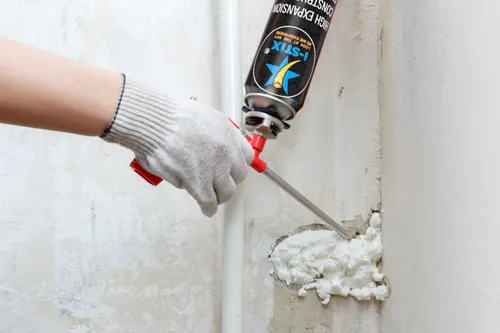
Depending on the width and depth of the crack, injection ports are drilled and fitted at precise intervals along the crack, usually every 150 to 300 mm. For full penetration, ports are positioned at 45° angles to cross the crack at its deepest point.
Resin Injection
Starting at the lowest port, epoxy or polyurethane resin is injected under carefully regulated low pressure. The injection process keeps going until resin shows up at the subsequent port, indicating that the crack has been filled there. We go methodically along the entire length of the crack.
Surface Finishing and Curing
The resin is allowed to fully cure following full injection. Port holes are sealed flush with the concrete surface after ports are eliminated. To complement the surrounding concrete profile, a cosmetic finish coat might be applied to surfaces that are visible.
Inspection & Documentation
We check for any leftover voids or untreated areas after the crack injection treatment is finished. Complete paperwork is supplied, including materials used, a completion certificate for your project quality records, and crack survey reports.
Crack Injection Across Every GCC Structure Type
Our crack injection services cover residential, commercial, industrial and infrastructure structures across Qatar, UAE and Saudi Arabia.
Residential Buildings
Retaining walls, structural slabs, villa basements, and apartment foundations in Doha, Dubai, Riyadh, and all GCC residential complexes.
Underground Car Parks
Water intrusion through basement parking lot walls and slab joints in commercial and mixed-use buildings is one of the most frequent uses of crack injection in the Gulf Cooperation Council.
Water Tanks & Reservoirs
Concrete water tanks, service reservoirs, and irrigation structures in Saudi Arabia, the United Arab Emirates, and Qatar are leaking; when necessary, injection materials suitable for potable water are used.
Bridges & Infrastructure
Structural crack injection on abutments, columns, and bridge decks for GCC infrastructure projects that comply with Saudi authorities, Ashghal, and RTA requirements.
Metro Structures & Tunnels
The only practical remedy for active water intrusion in tunnel linings and subterranean metro constructions is polyurethane injection under hydrostatic pressure.
Industrial Facilities
Epoxy injection restores load transmission and stops additional crack propagation under high traffic in GCC factories, warehouses, and industrial plants with structural floor cracks.
Commercial Buildings
Commercial buildings and mixed-use projects in Dubai, Abu Dhabi, Doha, and Saudi Arabian cities include basement walls, podium slabs, and structural components.
Retaining walls
Retaining walls of GCC residential complexes, infrastructural embankments, and landscaping developments are injected with both internal and external cracks.
Common Questions About Crack Injection Service
What distinguishes polyurethane crack injection from epoxy?
When load transfer needs to be reestablished in dry or slightly moist structural fissures, epoxy injection is used. Compared to the surrounding concrete, it is stronger and more stiff. For active, wet leaks, polyurethane foam injection works by reacting with moisture, expanding to fill the space, and instantly creating a flexible, waterproof cover. Epoxy won’t work on a damp fracture because the moisture inhibits effective bonding and curing.
Is it possible to inject cracks while water is actively leaking?
Yes, and this is the exact situation in which polyurethane foam injection is employed. To initiate its expansion process, PU resin requires moisture. Even under hydrostatic pressure, it reacts with the water when injected into a crack that is actively leaking, expands quickly, and shuts the leak in a matter of minutes. Because waiting for dry circumstances is impractical, it is the only workable remedy for GCC basement and underground structure leaks.
How can I determine whether a crack is non-structural or structural?
Load-bearing components, such as walls, slabs, beams, and columns, are impacted by structural fissures. They usually run across the element, may be deflected, and need to be strengthened by epoxy injection. Non-structural cracks, which are sealed to stop moisture intrusion rather than to restore strength, are brought on by thermal movement, shrinkage, or settlement and have no effect on load capacity. Before prescribing a treatment, our technicians accurately evaluate and categorise each crack.
In GCC settings, how long does crack injection last?
If the cause of the fracture has been addressed, a correctly performed crack injection utilising the appropriate material for the crack condition will result in a permanent seal that lasts the lifetime of the structure. The crack next to the injected part may reactivate if the underlying cause settlement, overloading, or corrosion continues to affect the structure. For long-term outcomes in GCC buildings, accurate crack assessment and root cause identification prior to injection are crucial.
What is the minimum crack width required to enable injection?
Crack injection works well on cracks as small as 0.5 mm for polyurethane foam and as small as 0.1 mm for epoxy systems. Injection can effectively fix the majority of visible concrete cracks, which usually begin at 0.2 to 0.5 mm. Injection may not be appropriate for extremely fine surface crazing or map cracking; instead, surface-applied waterproofing coatings may be needed. The right strategy for each unique fracture condition will be verified by our evaluation.