Cementitious waterproofing is the quiet workhorse of Gulf construction. It is affordable, it bonds straight to concrete, and it copes with the standing water you find in tanks, basements, and wet areas. Here is how it works, where it belongs, and where a Qatar contractor should reach for something else.
In this article
What cementitious waterproofing actually is
Cementitious waterproofing is a cement based coating mixed with fine sand and active chemicals that stop water passing through concrete. You buy it as a powder, often with a separate liquid polymer, and you mix it on site. Once it cures it becomes part of the surface rather than a film sitting on top. That is the main reason engineers across Qatar keep specifying it. It will not peel away the way some paints do, because it has chemically bonded to the substrate.
There are two broad types. The rigid kind sets hard and stays put, which is fine for surfaces that will not move, such as a concrete water tank. The flexible kind carries added polymers so it can stretch a little when the structure shifts or when temperatures swing, which they do hard between a Doha afternoon and an air conditioned interior.
Why it suits Gulf concrete
Concrete in the Gulf takes a beating. Ground water in many coastal areas carries salt, and salt is what corrodes the steel reinforcement inside a slab. Once that steel rusts it expands, the concrete cracks, and water finds an easier path in. A cementitious coating slows that whole cycle down.
It also handles negative side pressure, which matters more here than people expect. A basement in Doha or Lusail often sits below the water table, so water pushes against the inside face of the wall, not just the outside. Cementitious systems can be applied to that inner face and still hold, where a stuck on membrane would simply be forced off. For retaining walls, lift pits, and below grade tanks, that property does a lot of quiet work. It is one of the reasons our waterproofing services in Qatar still lean on it for structural and below grade work.
The application, step by step
Good cementitious waterproofing is mostly about preparation. Skip the prep and the best product on the market will fail.
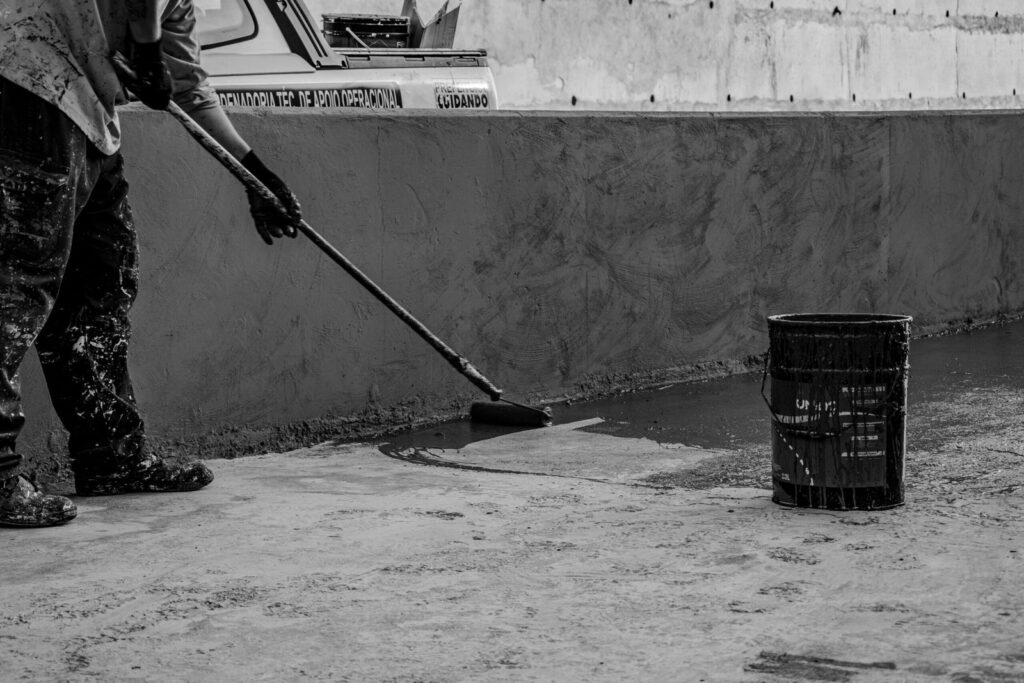
First the surface gets cleaned back to sound concrete. Laitance, dust, oil, and loose material all have to go, usually by wire brushing, grinding, or pressure washing. Cracks and honeycombing are cut out and patched with a repair mortar. The surface is then saturated with water until it is damp but not flooded, because a bone dry substrate pulls water out of the coating too fast and weakens the bond.
Mixing follows the manufacturer ratio exactly. Adding extra water to make it spread more easily is the most common site mistake, and it cuts the strength of the finished layer. The first coat goes on by brush or trowel, worked well into the surface. Once it has set enough to take a second pass, usually a few hours later, the second coat goes on at right angles to the first so there are no thin lines. Most tank and basement specifications call for two coats, sometimes three on the negative side.
Then it cures. In Qatari heat that means keeping the coating damp, often with a fine water spray or a covering, for two to three days so it does not flash dry and craze. Rushing this stage is where a lot of callbacks come from.
The pattern behind almost every cementitious failure is the same: poor prep, too much mixing water, or no curing. None of those are product faults.
Where cementitious coatings fall short
This is where an honest contractor earns trust, because cementitious waterproofing is not the answer for everything.
It does not bridge moving cracks well. A roof slab that expands and contracts all day, or an expansion joint, needs something that stays elastic, which is where polyurethane and liquid membranes come in. The rigid versions in particular will crack if the structure moves under them. It is also not the right pick for a surface that will be walked on or driven over without a screed or tile on top, because it is a waterproofing layer, not a wearing surface.
For exposed roofs in direct sun, a polyurethane or a torch applied membrane usually outlasts a bare cementitious coat. We tend to keep cementitious systems for tanks, basements, foundations, bathrooms, and wet areas, and match roofs and joints to a flexible system instead.
Getting the job right the first time
If you are specifying or buying waterproofing for a project in Qatar, ask the contractor how they prepare the substrate and how they cure the coating, not just which brand they use. The answer tells you more about the result than the data sheet does.
Compass has been detailing and applying these systems on tanks and basements across the country for years, and the jobs that last are the ones where nobody cut the boring steps. If you want a straight assessment of what your structure actually needs, talk to our team before the concrete is poured, not after the first leak.