
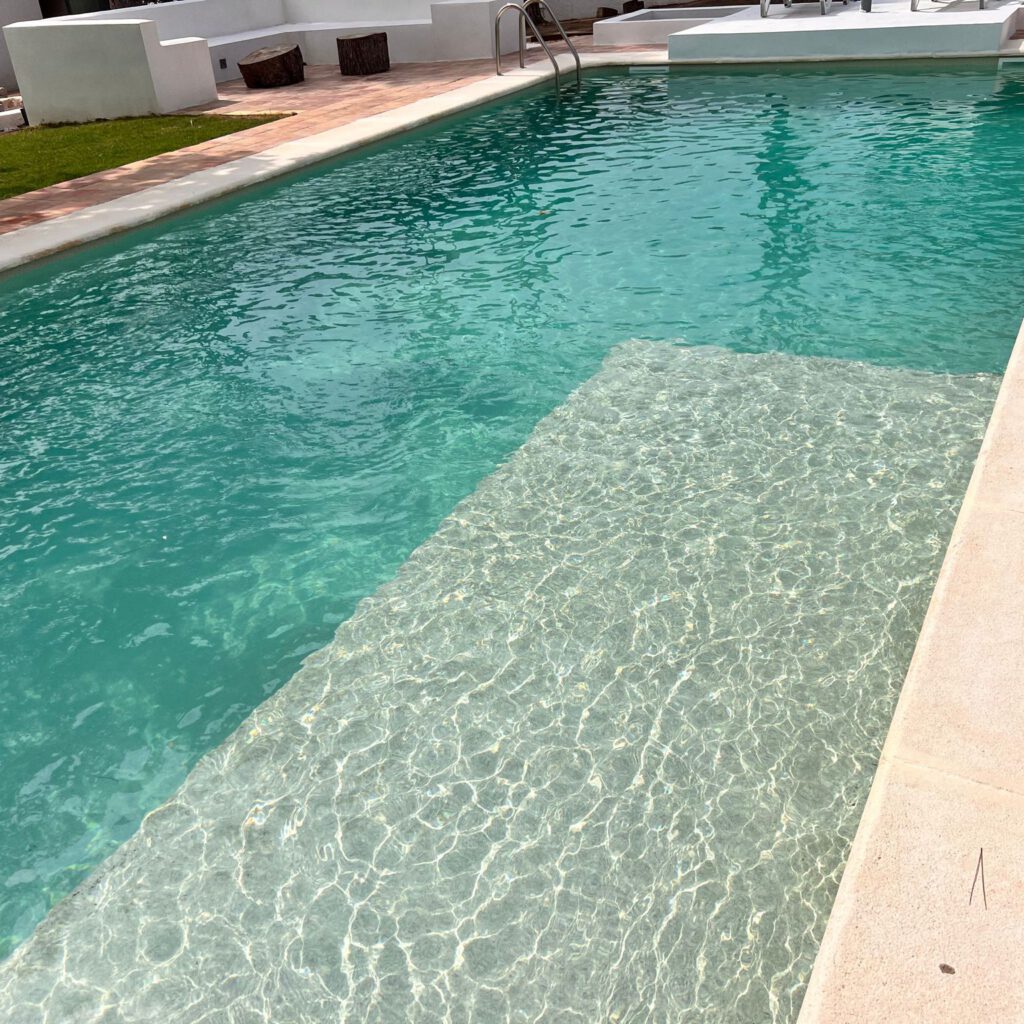
A swimming pool is one of the hardest waterproofing tests a building will ever face. It holds a full head of water against the shell every hour of every day, while Doha’s heat pushes the concrete through constant expansion and contraction underneath it. Get the waterproofing wrong here and the pool does not just look tired, it drains itself overnight or pushes water into whatever sits below it. Here is what actually keeps a pool watertight in this climate.
In this article
Why a pool is not just another wet area
A bathroom sees water for a few minutes at a time, then dries out. A swimming pool sits under a permanent column of water for the entire life of the building, and that water is pushing outward through every joint, crack and pipe penetration in the shell around the clock. Add Qatar’s heat, which swings the structure between a scorching afternoon and a much cooler night, and the concrete is moving while it carries that constant hydrostatic load. Very few surfaces in a building get tested this hard, this often. Pool waterproofing has to be treated as its own discipline, not an extension of bathroom waterproofing with bigger tiles.
That is also why a pool that “looks fine” for a year or two can still be building up trouble. Small leaks often stay invisible until a tide mark appears on a plant room wall below, or the pool starts needing a suspicious amount of top-up water. By the time it is obvious, the fix is usually bigger than it would have been at construction stage.
The two layers that both have to hold
Every pool actually needs two separate waterproofing decisions, not one. There is the structural waterproofing, built into or applied directly onto the concrete shell, and there is the finish layer on top of that, whether it is tiling, a pool render, or a liner. It is easy to assume the finish is doing the job, especially once it is tiled and looks sealed. It is not. Tile grout was never designed to hold back a permanent column of water on its own.
Get the structural shell right first, using a proper cementitious or liquid membrane system suited to permanent immersion, and treat the finish as the second line of defence rather than the only one. Our liquid membrane waterproofing systems are built for exactly this kind of sustained water contact, not just splash-zone protection.
What actually causes pool leaks here
Chlorinated water is harder on cementitious systems than plain water, and years of dosing slowly attacks a weak or under-specified coating. Thermal cycling opens hairline cracks at movement joints that were sealed with the wrong material, or not sealed at all. Where the water table sits high, which is common close to the coast, emptying a pool for maintenance can let groundwater push the wrong way against an unsupported shell.
Most leaks, though, trace back to a small number of predictable spots rather than a mystery crack in the middle of a wall. Light niches, skimmer boxes, the main drain, and the internal corner where the wall meets the floor account for the majority of call-outs we see.
Almost every pool leak we get called out for started at a fitting or a corner, never in the middle of a flat wall.
The detailing that decides whether it lasts
This is where a pool waterproofing job is won or lost. Waterstops belong at every construction joint, not just the obvious ones. Movement joints need a flexible sealant that can actually move with the structure, not a rigid grout fill that will crack the moment the concrete flexes. Fittings, lights, inlets, the main drain and the skimmer, all need reinforcing tape or fillets and extra coats around the penetration, since a straight run of membrane will never be the weak point, the edges always are.
A proper flood test, held for several days before any tiling starts, is the step that gets skipped most often when a schedule is tight. It is also the one that catches problems while they still cost nothing to fix. Our waterproofing services team builds a flood test into every pool programme for exactly that reason.
New build versus fixing a leaking pool
A new pool lets you build waterproofing into the shell from day one, which is the cheapest and most reliable route by a wide margin. Every joint and penetration can be detailed properly before the first drop of water goes in, and the flood test happens before anyone has committed to a finish.
Refurbishing a pool that already leaks is a different job entirely. You are usually waterproofing from the inside face only, and the leak you can see is not always where the water is actually getting in. Diagnosis has to come before treatment. Tracing the path of the water, checking every fitting and joint, and confirming the real source saves you from redoing tile work over a repair that never addressed the actual problem. Our crack injection service is often part of that diagnosis-led repair, sealing the specific path water is taking rather than recoating the whole shell and hoping.
A pool is not a surface you waterproof once and forget. It is under permanent load in a climate that never really lets the structure rest. Specify it properly at the start, detail the corners and fittings with real care, and a pool shell in Qatar can go years without a single leak. Cut corners on any of it, and the water will eventually find the one spot that was rushed.